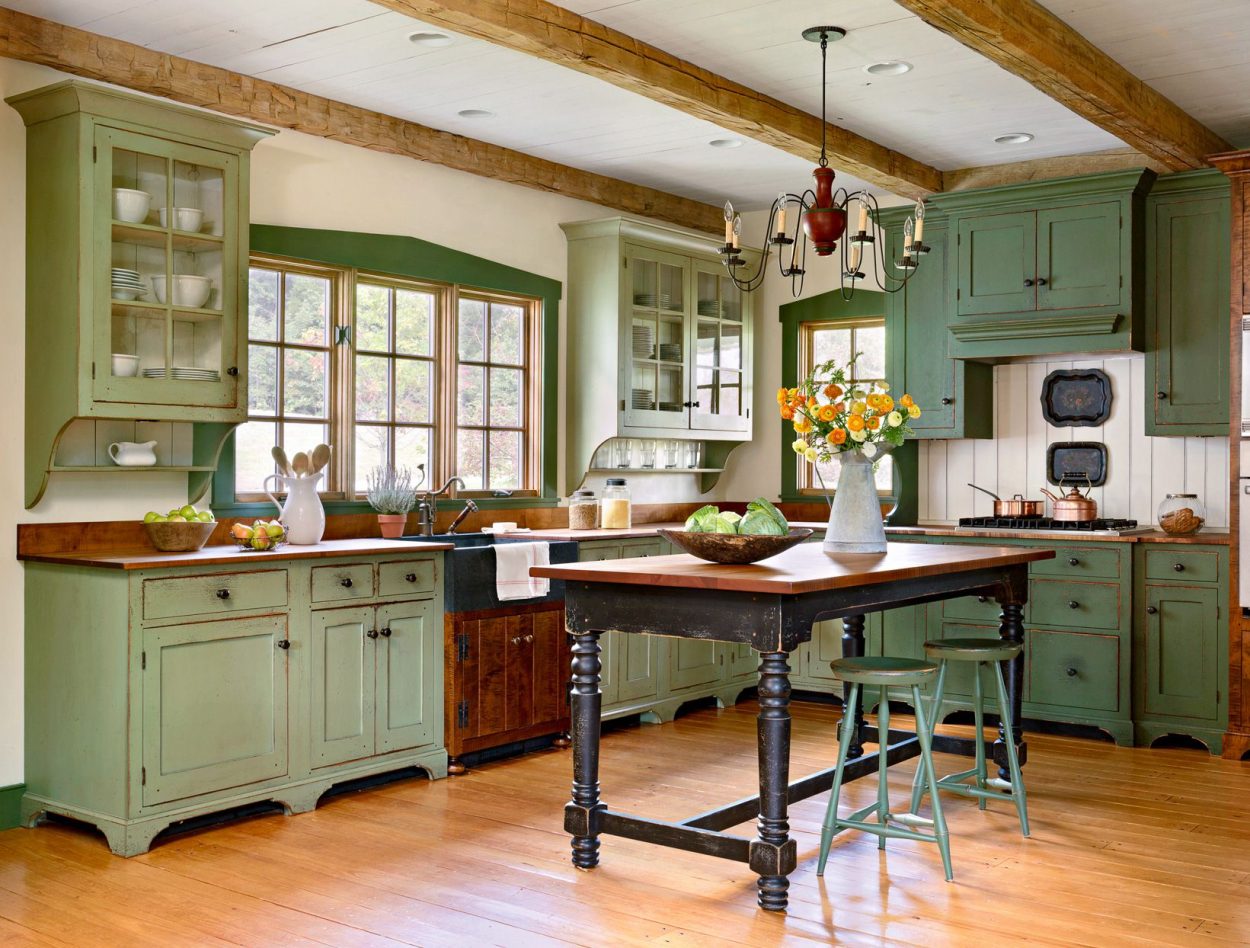
There’s a reason farmhouse sage green kitchen cabinets appear in nearly every home renovation mood board right now—and it’s not just a trend. Sage green occupies a rare design sweet spot: it’s bold enough to be interesting, soft enough to be livable, and rooted in nature in a way that feels genuinely timeless. It pairs perfectly with brass hardware and reclaimed wood accents to create a space that feels both fresh and historic.
If you’ve been considering making the leap, here’s everything experienced designers know about getting it right.
What Makes Sage Green Work in a Kitchen
Sage green is a grayed, muted green – more dusty and complex than bright or lime greens. This complexity is what makes it work:
- It reads differently in different light (warmer in golden morning light, cooler and more blue-gray in overcast light)
- It bridges warm and cool palettes – works with both brass and chrome hardware
- It pairs naturally with wood tones, which are everywhere in farmhouse kitchens
- It references nature and the garden without feeling forced
- It’s deeply flattering next to white walls and natural stone countertops
Sage Green Shades: Not All Are Equal
There’s a wide range under the “sage green” umbrella, and the undertones change everything.
| Shade Profile | Undertone | Best Pairing | Vibe |
|---|---|---|---|
| Classic sage | Gray-green | White walls, marble, brass | Soft, balanced |
| Warm sage | Yellow-green | Warm wood, cream, copper | Cozy, organic |
| Cool sage | Blue-green | White, chrome, stone | Fresh, modern |
| Deep sage | Dark, forest-adjacent | Walnut, aged brass, terracotta | Dramatic, moody |
| Pale sage | Near-neutral, very soft | Any light palette | Subtle, airy |
Popular paint colors used for sage green kitchen cabinets:
- Benjamin Moore Camouflage
- Sherwin-Williams Clary Sage
- Farrow & Ball Mizzle or Cooking Apple Green
- Benjamin Moore Pale Jade
- Behr Dusty Miller
Always test your chosen shade on a cabinet door in your actual kitchen light before committing. The same color looks dramatically different in north-facing versus south-facing kitchens.
The Perfect Farmhouse Pairings
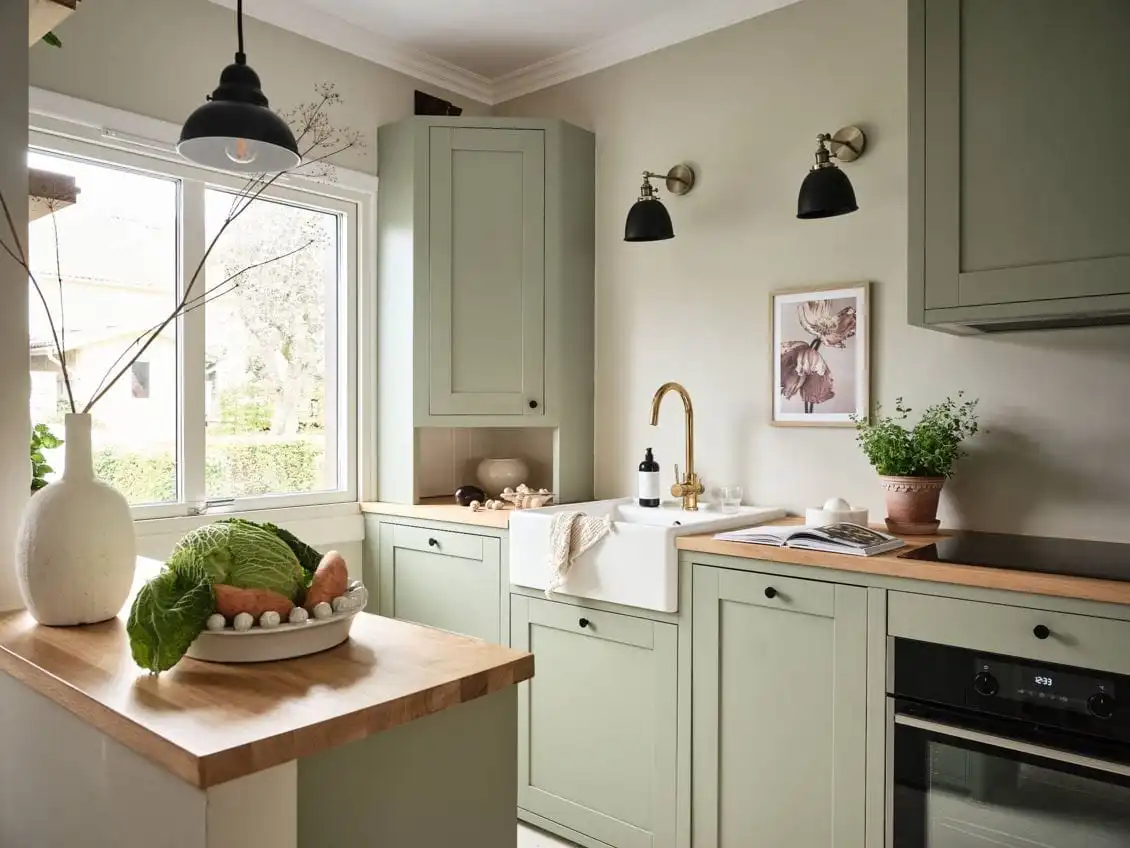
Countertops
- White or cream quartz with soft veining – the most popular choice; clean and timeless
- Butcher block – warmth and texture that feels authentically farmhouse
- White marble or marble-look quartz – elegant; adds refinement to the rustic vibe
- Concrete or leathered stone – more industrial; works with darker sage
Hardware
Hardware is where sage green really shines – it’s flattering with almost every finish.
| Hardware Finish | Effect With Sage Green |
|---|---|
| Brass / unlacquered brass | Warm, classic, most popular |
| Matte black | Modern farmhouse, graphic contrast |
| Aged bronze | Rustic, vintage, earthy |
| Brushed nickel | Clean, neutral, no-fail choice |
| Copper | Warm and unique; works best with warm sage |
Brass and sage green is the combination that has defined the current farmhouse aesthetic. It’s warm, organic, and genuinely beautiful together.
Backsplash
- White subway tile (especially handmade/zellige) – classic farmhouse foundation
- Cream or off-white tile – softer, more natural than stark white
- Terracotta or warm earth tile – leans into the organic, garden theme
- White shiplap – very farmhouse, for those leaning into the cottage look
- Natural stone slab – more refined; elevated farmhouse
Upper vs Lower Cabinets: Which Gets the Green?
You have two main approaches:
All sage green: Full commitment. Works beautifully in kitchens with ample natural light and white walls. Can feel heavy in darker or smaller kitchens.
Lower cabinets sage, uppers white or cream: The most universally flattering approach. Sage green grounds the lower zone while white keeps the upper half light and open. Works in any size kitchen.
Two-tone reverse (uppers sage, lowers white): Less common but striking. Creates a top-heavy visual that works best in kitchens with very high ceilings or open shelving rather than upper cabinets.
The Human Element: What Makes Sage Green Feel Different
Talk to anyone who has sage green cabinets and they’ll tell you the same thing: the kitchen feels *calmer* than it did with white or gray cabinets. There’s something about the muted, nature-referenced color that makes the most-used room in the house feel like a place you want to linger.
It doesn’t demand attention the way navy or black cabinets do. It doesn’t recede into the background the way white does. It simply sits there looking quietly, beautifully right.
Farmhouse sage green kitchen cabinets aren’t a flash-in-the-pan trend – they’re a reflection of a broader shift toward kitchens that feel warmer, more human, and more connected to the natural world. And that’s a direction that doesn’t go out of style.